Up until 3 days ago I was still using the bad deoderant with aluminum and all sorts of muck. Yeah yeah, I know, but natural deodorant smells horrible and doesn't work for me and I think smelling like BO is pretty much the grossest thing ever. So I held out. But then the other morning, as I was brushing my teeth with my baking powder concoction, I had a thought: what if my love affair with baking soda could go even further? I wet my underarms a little, smoothed some baking soda on and went about my day. This was Saturday. I haven't showered since then (it's Summer and I'm lazy), have gardened more than 10 hours in that time, spent a while outdoors, gone on some walks, and my arm pits still don't stink! It's a miracle! Today they got a little sweaty, whereas before they stayed dry even when I was sweaty elsewhere. I don't have any white gunk on my clothes (including two black shirts.)
My point: It actually works better than convention antipersperants, has very little packaging, and won't fill my body with free radicals. Huzzah!
Also: I have power again.
Showing posts with label baking soda. Show all posts
Showing posts with label baking soda. Show all posts
Monday, May 19, 2008


Wednesday, March 26, 2008
Green Clean

It's Spring Cleaning Time! Not only because it's my Spring Break at present, but also because during the thesis writing (It's DONE!) my house turned into a sty. I mean, really... it was a total yuck fest. Last spring I used some Method cleaner, but there was also some serious bleach involved. I used disposable cleaning wipes, swiffer carpet sweeper pads, disposable mopping pads and a ton of paper towels. This year, no thanks.
Here's what I've done:
~Cleaned out the now plugged-in fridge with vinegar, baking soda and Borax combined in an old Method spray bottle.
~Stopped my sink drain with a jar lid and 'bleached' it with white vinegar made into a paste with baking soda. Then scrubbed it with water mixed with lavender oil. To make every smell fresh, I stuck half a lemon in the garbage disposal and turned it on.
~Scrubbed the wood floors with a combo of vinegar and water. All I have to accomplish this is a swiffer wet. How wasteful! But since I already have it, I think it's more wasteful not to use it. I did, however, stick the swiffer wet in my washing machine with a load of rags so I could use it again on the bathroom floor.
~Peeled up my FLOR carpet squares and scrubbed them by hand in the sink with regular dish soap and warm water. I used a toothbrush on stains.
~Used the borax/vinegar/baking soda/water cleaner in the bathroon too for the floor, toilet, and sink.
~Took all the area rugs outside and beat them the old fashioned way (well ok, with a broom. I don't have one of those rug beater thingies.)
~Went through my clothes and things, setting aside what I no longer need/what doesn't fit. I'll try to pawn things off on friends next week, and what they don't want will go to Goodwill.
~Brought my 5 zillion magazines to the office at school so other people can read them too.
~Cleaned the grimmy window sills (which have been bombarded with snow and grossness all Winter since there is no storm window) with Method grapefruit cleaner.
~Boiled water and poured it all over my stove. Let it sit a bit, and them scrubbed all the cast iron bits in the sink to get the grease off. Finished up with method grapefruit surface cleaner.
~Left all the windows open to get rid of the rather vinegary smell.
~Used Method shower cleaner on the shower. It was never very dirty anyway, but I'd like it to sparkle a little more. Ideas?
Hooray for not spending any money on cleaning because I already had the stuff! Hooray for not buying those Clorox surface cleaning wipes or paper towels or bleach pens or Swiffer sheets or Comet toilet cleaner! Normally after cleaning the house my bathroom garbage can is entirely filled with used towels and cleaning pads. No more! I keep cleaning rags seperate from the kitchen ones and when one gets too dirty, it gets dropped into the jar of vinegar to soak. Once I'm all done for the day, i send them all through the Wonder Wash and voila! Good as new. Rags only get disgusting if you let them lay about for weeks without cleaning them.
Sunday, March 16, 2008
In Which I Discuss Baking Soda... Yet Again.
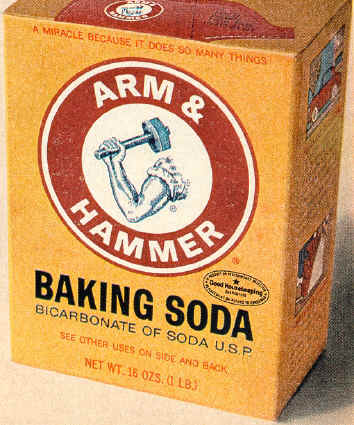
I've been thinking about this for a few weeks, and then commenter Dani brought it up too: Where does all this Baking Soda I'm swiftly becoming obsessed with come from? Is it natural? How is it produced? Transported? Etc. These are good questions, and not ones that are easy to find the answers to. Production and consumption cycles have grown so complex that sometimes we think we're making the green choice and it turns out not to be so. I'm still backing Baking soda though, and here's why:
Baking Soda is Soduim Bicarbonite (NaCO3) and it does exist in nature. People used to mine for it (or actually the soda ash, aka ore trona, which is quite plentiful in the US.) Now we create a more purified version by fusing stuff (Calcium Carbonate, Sodium Chloride, Ammonia and Carbon Dioxide) in a lab. Yes, the process does emit CO2 into the air, but apparently no more than any other factory-produced good (which is practically everything.) Baking Soda can also be made by another method because 'trona' is plentiful here. In the other common method, one dissolves the trona in water and injects it with CO2. Natural Gas is used in the process, as is a small amount of ammonia, but far less of either is used in bicarb production than in the production of say, bleach or drano or ammonia itself. The majority of the Baking Soda for the whole world is produced in this country, so at least it doesn't have to travel too far! In other parts of the world it's made with limestone and brine.
Church and Dwight is the father company of Arm & Hammer, which is the brand I'm using because it's what I have right now. I've always hated Church and Dwight as a company, but this is because the ad agency I used to work for dealt with them constantly. They were stingy and stodgy, an old-school company weary of any innovation and slow to pay their bills. Then again, baking soda hasn’t changed much over the years so maybe they’re right not to budge. And I shouldn't let my interpersonal conflicts with their employees color this post too much!
In a 1993 business report, I found out a bunch of cool stuff about the company. It started including wildlife picture cards in boxes of Baking Soda in 1888 to raise awareness about endangered species. How cool! In 1908 Church & Dwight began using recycled paper in their boxes! Who knew anyone recycled back then? In 1990 they hired an executive to define their environmental policy – something other companies swiftly copied to get in onboard the trend train. Apparently, C&D focuses on ‘beginning of the pipe’ pollution prevention, rather than ‘end of the pipe’ pollution clean-up, which is music to my ears. However, the rest of the business report reads more like a PR document than a concrete explanation of how the company functions in a green way. This makes sense. Green means money, after all. C&D donates quite a bit of cash to environmental education and stewardship. They also focus the report on how Sodium Bicarbonate could be used by other businesses to lessen their environmental impact since it is a cleaning agent without any toxins, and one that actually helps our municipal water supply when it’s poured down the drain (the how was lost on me in the technical prose.) The process of production itself was not addressed, although they do highlight the safety of their workers as top priority. This omission could be due to the fact that the report I read was from 15 years ago – not as much emphasis was placed on carbon footprints back then, so companies weren’t expected to reveal theirs. See the full report here . The C&D website itself talks about products and tips for using them, but doesn't include any other company info so this is all I got.
For those who do not like supporting large companies, there are small natural food companies that make Baking Soda too, although it seems they're more expensive.
In Short: the production of Baking Soda isn't carbon neutral, but it has a much smaller production footprint than other cleaning products I researched. Perhaps more importantly though, it comes in a box and it's nontoxic. Throughout its entire product lifecycle, it's the best option I've found thus far.
Baking Soda is Soduim Bicarbonite (NaCO3) and it does exist in nature. People used to mine for it (or actually the soda ash, aka ore trona, which is quite plentiful in the US.) Now we create a more purified version by fusing stuff (Calcium Carbonate, Sodium Chloride, Ammonia and Carbon Dioxide) in a lab. Yes, the process does emit CO2 into the air, but apparently no more than any other factory-produced good (which is practically everything.) Baking Soda can also be made by another method because 'trona' is plentiful here. In the other common method, one dissolves the trona in water and injects it with CO2. Natural Gas is used in the process, as is a small amount of ammonia, but far less of either is used in bicarb production than in the production of say, bleach or drano or ammonia itself. The majority of the Baking Soda for the whole world is produced in this country, so at least it doesn't have to travel too far! In other parts of the world it's made with limestone and brine.
Church and Dwight is the father company of Arm & Hammer, which is the brand I'm using because it's what I have right now. I've always hated Church and Dwight as a company, but this is because the ad agency I used to work for dealt with them constantly. They were stingy and stodgy, an old-school company weary of any innovation and slow to pay their bills. Then again, baking soda hasn’t changed much over the years so maybe they’re right not to budge. And I shouldn't let my interpersonal conflicts with their employees color this post too much!
In a 1993 business report, I found out a bunch of cool stuff about the company. It started including wildlife picture cards in boxes of Baking Soda in 1888 to raise awareness about endangered species. How cool! In 1908 Church & Dwight began using recycled paper in their boxes! Who knew anyone recycled back then? In 1990 they hired an executive to define their environmental policy – something other companies swiftly copied to get in onboard the trend train. Apparently, C&D focuses on ‘beginning of the pipe’ pollution prevention, rather than ‘end of the pipe’ pollution clean-up, which is music to my ears. However, the rest of the business report reads more like a PR document than a concrete explanation of how the company functions in a green way. This makes sense. Green means money, after all. C&D donates quite a bit of cash to environmental education and stewardship. They also focus the report on how Sodium Bicarbonate could be used by other businesses to lessen their environmental impact since it is a cleaning agent without any toxins, and one that actually helps our municipal water supply when it’s poured down the drain (the how was lost on me in the technical prose.) The process of production itself was not addressed, although they do highlight the safety of their workers as top priority. This omission could be due to the fact that the report I read was from 15 years ago – not as much emphasis was placed on carbon footprints back then, so companies weren’t expected to reveal theirs. See the full report here . The C&D website itself talks about products and tips for using them, but doesn't include any other company info so this is all I got.
For those who do not like supporting large companies, there are small natural food companies that make Baking Soda too, although it seems they're more expensive.
In Short: the production of Baking Soda isn't carbon neutral, but it has a much smaller production footprint than other cleaning products I researched. Perhaps more importantly though, it comes in a box and it's nontoxic. Throughout its entire product lifecycle, it's the best option I've found thus far.
Wednesday, March 5, 2008
Two Baking Soda Experiments From This Morning
Experiment #1:
I have long hair and it clogs the shower drain sometimes. Like right now. But instead of dragging my butt to target, spending my hard-earned cash on toxic chemicals, probably buying a bunch of other crud as well that I have no need for, and coming back to pollute the water supply, I tried a different way. I dumped baking soda down the drain, poured some vinegar in there too, watched it sizzle, and then dumped hot water down after 15 minutes or so.
Yeah yeah yeah, you say. So did it work?
Well, not really. The amount of water that stockpiles when I shower has lessened... but it's still clogged. Me thinks this is a multiple tries sort of thing. And then, instead of letting it get bad again maybe i'll do it once every two weeks or so.
Experiment #2:
I ran out of my girly vanilla mint Crest toothpaste this morning. Yes, I could slice open the tube and get the last remnants and I will tomorrow, but I was on a baking soda kick. I used baking soda and water to brush my teeth. This works really well. Teeth feel and look clean. I miss the minty-fresh taste my mouth gets with the chemically version, though. Maybe i'll get over this. Or maybe there's a way to infuse the toothpaste with mint leaves? I know Toms of Maine has a minty version, but I'm still saddened by the amount of packaging involved, so i'll keep trying to make my own and keep you abreast of the mouth-cleansing developments.
The Consequences in Cash?: A big bottle of organic white vinegar costs me less than 1.89$, and a big box of baking soda is also less than 2 bucks. Drano would set me back 5 bucks, and new toothpaste is 3.25$ (my fun kind, anyway.) Total Savings = 4.25$-ish
I think I'll buy myself an organic soy latte!
Subscribe to:
Posts (Atom)
